







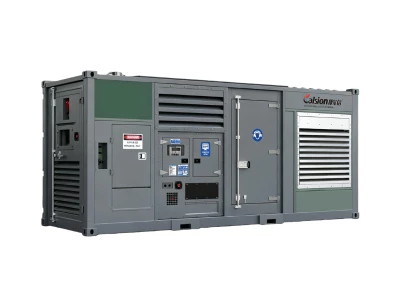
Industrial Diesel Generators for Data Centers: Power Requirements and Application Considerations
Release time: 2026-08-10
Data centers have far higher requirements for power supply stability than ordinary industrial and commercial scenarios. A power outage can affect servers, storage devices, network systems, and cooling equipment. Therefore, industrial diesel generators are typically an important component of data center backup power. However, for data centers, generator selection cannot be based solely on rated power; it also requires comprehensive consideration of factors such as IT load, UPS capacity, cooling system, transient load, redundancy architecture, and continuous operation capability. Calsion specializes in diesel generators and power solutions, providing customers with more reasonable unit configurations and backup power solutions tailored to the load requirements and application environments of different data centers.
Table of Contents
I. Why Do Data Centers Need Industrial Diesel Generators?
The core characteristic of data centers is high load continuity, and the impact of power outages usually extends beyond just equipment shutdown.
Under normal mains power conditions, data centers primarily rely on the power grid. When a grid failure occurs, the UPS typically provides short-term power support, buying time for the diesel generators to start and switch over. Once the generator sets reach stable operating conditions, power is supplied to critical loads through switching equipment such as ATS.
Therefore, a complete data center backup power system typically includes:
* Mains input system
* UPS (Uninterruptible Power Supply)
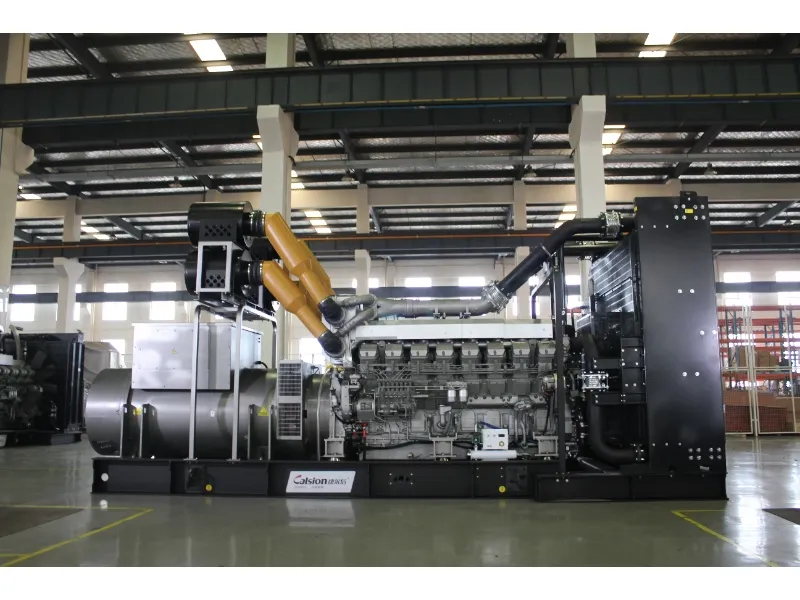
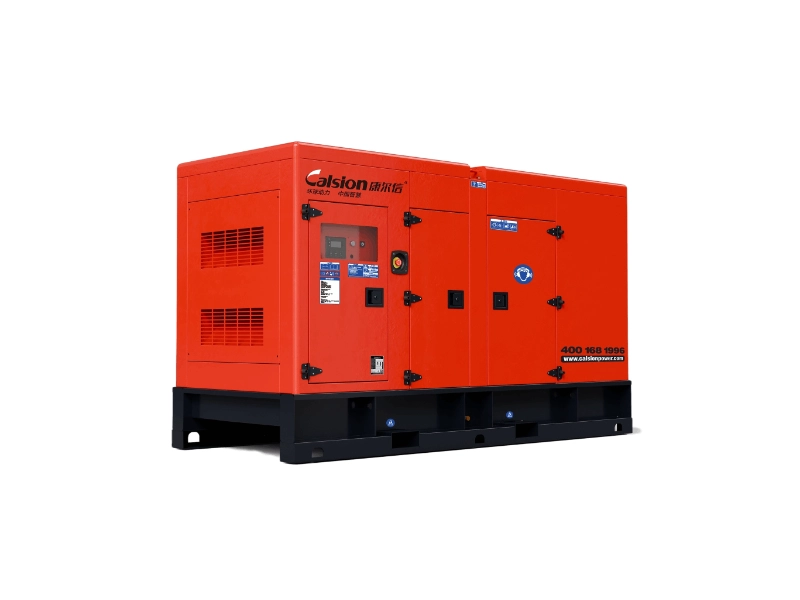
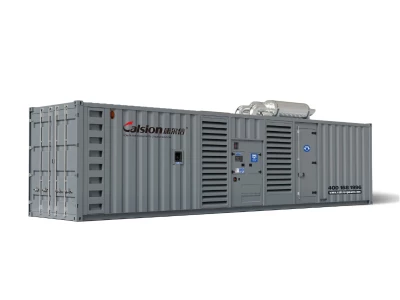
* Industrial diesel generator set
* ATS (Automatic Transfer Switch)
* Power distribution system
* Fuel storage and delivery system
* Monitoring and control system
Diesel generators are not isolated devices, but rather a component of the overall data center backup power architecture.
II. How much power does a data center diesel generator need?
This is one of the most critical questions in generator selection.
Many users directly calculate based on the server’s IT load. For example, if the total load of the data center’s IT equipment is 1000kW, they assume a 1000kW diesel generator is sufficient. However, in actual engineering projects, this calculation method is often incomplete.
The actual total load of a data center can generally be understood as:
Total Load = IT Load + UPS Losses + Cooling System Load + Power Distribution and Auxiliary Load + Other Critical Equipment Load
Among these, the cooling system can be a significant additional load. Especially in applications such as high-density servers, AI computing, and GPU clusters, as rack power density increases, the impact of the cooling system on overall energy demand becomes increasingly apparent. Therefore, the capacity of a diesel generator cannot be simply selected based on “server power,” but should be calculated based on the actual simultaneous operating load of the data center under conditions of a mains power outage.
A simple selection approach:
For example, if a data center’s IT load is 1000kW, UPS and power distribution losses are approximately 100kW, and the cooling system and auxiliary equipment load is 500kW, then the designed operating load may already reach around 1600kW.
At this point, the load power factor, environmental derating, transient performance, and future expansion requirements also need to be considered, and the final unit capacity may need to be higher than 1600kW.
Therefore, in actual projects, final generator sizing should be verified using a detailed load list and the manufacturer’s sizing or selection tools, rather than simply relying on empirical values.
III. Why are start-up shocks and transient loads so important?
In addition to steady-state power, data center diesel generators also need to have good transient response capabilities.
When the mains power is interrupted, and the generator starts and connects to the load through the ATS, some loads may suddenly be added in the form of a large power step. For example, motor-driven equipment such as cooling pumps, fans, and air conditioning compressors may generate high starting currents during startup.
If the generator has sufficient capacity for normal operation but cannot adequately handle a sudden increase in load, the following may occur:
* Engine speed decrease
* Output frequency fluctuation
* Instantaneous voltage drop
* UPS may switch to battery mode
* Some equipment protection trips
ISO 8528-5:2025 also emphasizes that during generator set design and selection, the effects of load characteristics, nonlinear loads, and sudden load connection or disconnection on voltage and frequency transient characteristics must be considered.
Therefore, the selection of diesel generators for data centers should not only consider the kW/kVA rated capacity but also the engine speed control system, alternator, excitation system, and voltage and frequency recovery capabilities after load steps.
IV. How should UPS and diesel generators be matched?
There is a very close relationship between UPS and diesel generators.
UPS is primarily responsible for providing instantaneous, uninterrupted power during mains power failures, while also providing a buffer time for diesel generator startup. Diesel generators are responsible for continuously providing energy during prolonged power outages. Modern data centers extensively utilize power electronic equipment such as rectifiers, UPS, and power conversion devices, which may generate a certain degree of nonlinear load. Therefore, when selecting a generator, it is necessary to confirm the compatibility between the generator and the UPS.
Key considerations include:
1. UPS rated capacity and actual load;
2. UPS input power factor;
3. Harmonic current and filtering method;
4. Generator voltage and frequency stability;
5. Control logic between the UPS and generator;
6. Transient response during load switching.
If the generator capacity is too small, the UPS may frequently enter battery mode; if the generator capacity is significantly too large, it may increase equipment investment and reduce efficiency under low load conditions.
V. What kind of redundancy design is required for Tier III and Tier IV data centers?
For high-reliability data centers, a single diesel generator is usually insufficient to fully meet system reliability requirements.
The Uptime Institute classifies data centers into Tier I to Tier IV, with Tier III emphasizes Concurrent Maintainability, while Tier IV further emphasizes Fault Tolerance. As the Tier level increases, power systems require higher redundancy and fault isolation capabilities.
Therefore, engineering projects may adopt:
N architecture: Provides the capacity required to support the design load;
N+1 architecture: Adds one redundant unit or capacity module;
2N architecture: Provides two independent systems, each capable of supporting the required load;
2N+1 architecture: Adds further redundancy to a 2N configuration.
For example, when a data center requires 4 units to meet normal load, an N+1 architecture might configure 5 units. This way, if one unit is under maintenance or fails, the remaining units can still handle the design load.
The specific architecture needs to be determined based on the data center’s Tier targets, project budget, load growth plan, and local power regulations.
VI. Why is the fuel system also an important consideration for data centers?
How long a diesel generator can operate depends not only on the fuel tank capacity but also on the reliability of the entire fuel supply system.
For data centers, the following factors need to be considered comprehensively:
* Main fuel tank capacity;
* Daily fuel tank;
* Fuel transfer pump;
* Fuel lines;
* Automatic fuel replenishment system;
* Fuel level monitoring;
* Leak detection;
* Fuel filtration system.
Fuel storage requirements should be determined according to the data center’s design load, expected outage duration, local regulations, project specifications, and reliability requirements. For high-reliability facilities, the fuel system should also be designed with appropriate redundancy and monitoring.
Therefore, in large data center projects, diesel generators and fuel systems should be designed as a complete system, not just the generator itself.
VII. What else should be considered when actually purchasing an industrial diesel generator?
Besides power and redundancy architecture, it is recommended to focus on the following parameters:
First, the operating environment.
High temperature, high humidity, and high altitude environments will affect the actual output capacity of the diesel generator, requiring power adjustments based on the project location.
Second, rated power type. It’s crucial to clearly define different rating types such as Standby, Prime, and Continuous; simply comparing the maximum power on the product nameplate is insufficient. For Tier III and Tier IV projects, it is particularly important to verify that the generator system can reliably support the required design load for the expected outage duration.
Third, automation level. Data centers typically require units with automatic start-up, automatic switching, remote monitoring, and fault alarm functions to reduce delays caused by manual operation.
Fourth, ease of maintenance. Diesel generators are long-term backup equipment, making routine maintenance and regular testing critical. Data center layout, maintenance space, spare parts supply, and after-sales service all affect long-term operational reliability.
Fifth, future expansion.
If the data center plans to add server racks or build a new data center, the generator system should ideally have sufficient expansion capacity to avoid rebuilding the entire power supply system later.
VIII. How to rationally select industrial diesel generators for data centers?
In summary, the selection of diesel generators for data centers should shift from “single unit power” to “the capacity of the entire backup power system.”
A reasonable selection process can be summarized as follows:
Determine IT load → Calculate total facility load → Analyze UPS and nonlinear loads → Evaluate maximum load step → Perform environmental derating → Determine redundancy architecture → Verify fuel system → Confirm automatic control and paralleling schemes → Finally determine generator capacity.
Especially for large data centers, it is recommended that the load analysis and unit configuration be completed jointly by the diesel generator manufacturer, electrical engineers, and data center design team, rather than simply selecting a power level based on experience.
The selection of industrial diesel generators for data centers is essentially a comprehensive evaluation of power, stability, redundancy, and long-term operational reliability. From IT load calculation to UPS and cooling system matching, and to N+1, 2N, and other redundancy architecture designs, each step affects the actual operating performance of the backup power system. Calsion, with its experience in industrial diesel generator products and project applications, can assist customers in rationally configuring unit capacity, paralleling systems, and related supporting solutions based on the actual load, operating environment, and power supply requirements of the data center, providing stable and reliable backup power support for the data center.