







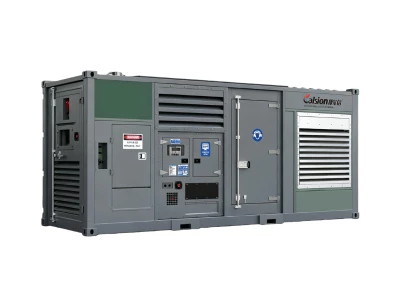
How Do Yuchai Diesel Generator Sets Handle Heavy Motor Starting Loads?
Release time: 2026-08-31
In industrial production and infrastructure projects, the startup of large motors, air compressors, water pumps, and other equipment often generates significant instantaneous loads, placing higher demands on the power response and power supply stability of diesel generator sets. Yuchai diesel generator sets can be configured with appropriate engine power reserves, starting systems, speed regulation, and voltage-control systems to better cope with heavy-load starting conditions. This article will analyze the key measures Yuchai generator sets take to address heavy-load starting from multiple technical perspectives.
What are the core challenges of heavy-load starting?
When a large motor starts, the instantaneous starting current may be significantly higher than the normal operating current. If the generator set capacity, engine power reserves, or control system are insufficiently matched, problems such as starting difficulties, voltage drops, and frequency fluctuations may occur.
| Heavy-Load Starting Challenge | Typical Impact | Generator Set Requirement |
| Starting Current Surge | A significant increase in current during motor startup | Strong load acceptance capability |
| Voltage Dip | Temporary voltage drop during startup | Fast AVR and excitation response |
| Frequency Fluctuation | Temporary engine speed reduction | Fast governor and fuel response |
| Sequential Starting | Multiple large loads starting one after another | Effective load management and sequencing |
How does Yuchai generator set handle heavy-load starts?
1. How does the engine provide sufficient power reserve?
The diesel engine is the power source for the entire generator set to cope with sudden load increases. Depending on the engine model, technologies such as turbocharging and charge-air cooling can improve air-intake efficiency and power response.
During heavy-load starts, the engine needs to quickly increase fuel supply and restore speed. If the engine’s power reserve is insufficient, a significant drop in speed is likely after a sudden increase in load. Therefore, in actual selection, it is necessary to assess the load-bearing capacity of the specific engine model and load characteristics, rather than just looking at the engine’s rated power.
2. Why does the starting system need to be properly configured?
The diesel generator itself also requires a reliable starting system. The configuration of the starter motor, battery, and related wiring directly affects whether the engine can quickly reach a stable operating state.
Especially in low-temperature environments or long-term standby conditions, battery condition, oil viscosity, and engine temperature all affect starting performance. Environmental conditions and the condition of the starting equipment should therefore be considered when configuring the starting system. Therefore, for heavy-load applications, the starting system should be configured appropriately based on the specific environment and engine model, and preheating and other auxiliary measures should be added when necessary.
3. How Do Speed Control Systems and AVRs Reduce the Impact of Sudden Load Application?
After heavy-load equipment is connected, both engine speed and generator output voltage will be affected.
The speed control system is mainly responsible for adjusting the fuel supply according to speed changes, allowing the engine to quickly recover to a stable speed; the AVR (Automatic Voltage Regulator) adjusts the excitation according to output voltage changes, allowing the voltage to recover as quickly as possible.
ISO 8528-5 states that the voltage and frequency characteristics under sudden load changes are related to factors such as the engine turbocharger system, speed governor, alternator, excitation system, AVR, and generator set rotational inertia.
Therefore, in heavy-load projects, the dynamic performance of these systems is just as important as the engine itself.
4. Why do large loads require staged starting?
If multiple large motors start simultaneously, a large instantaneous load will be formed. Compared to connecting the entire load at once, staged starting can reduce the impact of a single load.
For example: Generator starts → Base load connected → First large equipment starts → System stabilizes → Second equipment starts.
For large factories, pumping stations, mines, and engineering projects, the starting sequence can be designed according to equipment priority. If the motor itself allows, a soft starter or variable frequency drive (VFD) can also be used to reduce starting current.
How to select a Yuchai diesel generator set for heavy-load starting?
In actual projects, the following aspects can be evaluated:
| Selection Factor | Key Considerations |
| Generator Capacity | Normal operating load and maximum load |
| Motor Starting Demand | Motor power, starting current, and starting characteristics |
| Starting Method | Direct-on-line, soft start, or variable frequency drive (VFD) |
| Dynamic Response | Voltage and frequency recovery performance |
| Operating Conditions | High temperature, high altitude, low temperature, etc. |
| Load Characteristics | Single heavy load or multiple loads starting sequentially |
| Redundancy Requirements | Single-unit operation or parallel operation |
It is particularly important to note that generator set capacity calculations should not only consider the normal operating power of the equipment, but also take into account the motor starting characteristics and load connection sequence. ISO 8528-5 also requires consideration of factors such as the power requirements of the connected loads, motor starting characteristics, intermittent loads, and nonlinear loads when selecting generator set capacity and switchgear.
Which scenarios require a focus on heavy-load starting?
If Yuchai diesel generator sets are used in the following scenarios, heavy-load starting analysis is crucial:
Industrial plants: large machine tools, air compressors, water pumps, etc.;
Mining projects: crushers, conveying equipment, and large motors;
Construction projects: tower cranes, water pumps, and construction equipment;
Infrastructure: water supply and drainage pumping stations, HVAC systems, etc.;
Data centers: cooling systems and some motor-related auxiliary equipment.
For these scenarios, it is recommended to provide a complete load list and motor starting parameters at the beginning of the project, allowing the generator set supplier to verify capacity and dynamic performance.
The requirements for starting diesel generator sets under heavy loads are not only reflected in rated power, but also involve multiple aspects such as engine torque reserve, speed regulation response, voltage recovery capability, and load starting method. By rationally selecting the unit capacity and combining it with measures such as soft start and staged loading, the impact generated when starting large equipment can be effectively reduced. In terms of diesel generator sets and industrial power supply solutions, Calsion can conduct a comprehensive analysis based on the customer’s actual load type, equipment starting characteristics, operating environment, and power requirements, and provide corresponding unit selection and configuration suggestions for high-impact loads such as large motors, compressors, and water pumps. By coordinating the engine, alternator, control system, and load characteristics, Calsion helps customers develop generator configurations suited to their actual operating conditions.