







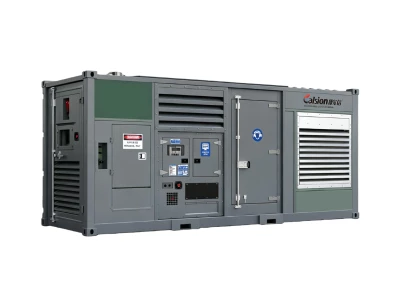
Industrial Diesel Generator Set Sizing: How to Calculate the Right Power Capacity
Release time: 2026-10-21
Industrial production demands an exceptionally high level of continuity and stability in power supply. Selecting an industrial diesel generator set with an inappropriate capacity can lead to wasted investment and excessive fuel consumption; in more severe cases, it may cause voltage drops or system shutdowns during the startup of critical loads or periods of peak operation. Consequently, the precise calculation of power capacity is the essential first step in selecting an industrial diesel generator set—a core requirement for ensuring both operational safety and cost-efficiency.
This guide explains how to calculate the appropriate industrial diesel generator capacity and identify the key specifications before purchasing a generator set.
Table of Contents
1. How Do You Calculate the Total Electrical Load?
The first step is to identify all electrical equipment that the generator must supply during a power outage. Typical industrial loads include pumps, compressors, production machinery, HVAC systems, lighting, and control equipment.
Prepare a load list containing each device’s rated power, quantity, power factor where applicable, and starting characteristics. Then determine which loads must operate simultaneously and which can be started sequentially.
The total running load can be estimated by adding the actual electrical input power of the equipment expected to operate at the same time. If only mechanical output ratings are available, motor efficiency must also be considered when calculating electrical input demand.
For example, if a facility requires 60 kW for production equipment, 15 kW for ventilation, and 5 kW for lighting and control systems, the estimated simultaneous running load is 80 kW.
However, this figure is only the starting point. Engineers must also evaluate motor starting requirements, load fluctuations, and any additional capacity needed for future expansion.
2. What Is the Difference Between kW and kVA?
Industrial containerised diesel generators are commonly rated in kilowatts (kW) and kilovolt-amperes (kVA). Understanding the difference is essential when comparing generator specifications.
Kilowatts measure active power, which performs useful work. Kilovolt-amperes represent apparent power, which accounts for the combined effects of voltage and current. Their relationship depends on the power factor.
kW = kVA × Power Factor
For example, a generator rated at 1250 kVA with a power factor of 0.8 provides 1000 kW of active power under its specified rating conditions.
The following table provides illustrative examples for preliminary capacity assessment. Actual generator selection must also account for the manufacturer’s rating conditions, load characteristics, and transient performance.
| Generator Rated Capacity (kVA) | Power Factor | Active Power (kW) | Typical Considerations |
| 1000 kVA | 0.8 | 800 kW | Large manufacturing facilities and industrial production plants |
| 1250 kVA | 0.8 | 1000 kW | Heavy-duty industrial equipment and large-scale processing facilities |
| 1500 kVA | 0.8 | 1200 kW | Mining operations, manufacturing plants, and industrial production lines |
| 2000 kVA | 0.8 | 1600 kW | Large industrial complexes, infrastructure projects, and critical manufacturing facilities |
| 2500 kVA | 0.8 | 2000 kW | Semiconductor fabs, advanced manufacturing facilities, and large data centers |
| 3000 kVA | 0.8 | 2400 kW | Large-scale semiconductor fabs, major industrial plants, and mission-critical data centers |
These examples assume a rated power factor of 0.8. They are not recommendations for specific applications because the actual required capacity depends on the complete load profile and the generator’s performance characteristics.
3. Why Must Motor Starting Power Be Considered?
Many industrial devices draw substantially more current during startup than during normal operation. Motors used in pumps, compressors, conveyors, and ventilation systems can create significant transient loads.
If several large motors start simultaneously, the generator may experience excessive voltage dips or frequency deviations. These conditions can affect sensitive equipment and prevent motors from accelerating properly.
To avoid these problems, engineers should identify the largest motor, determine its starting method, and check its starting current and acceleration requirements. Direct-on-line starting typically creates a higher inrush current than methods such as soft starters or variable frequency drives, although the actual performance depends on the equipment and operating conditions.
Where appropriate, starting large motors sequentially can reduce peak demand. Generator sizing should therefore consider both steady-state running loads and the most demanding expected load step.
4. How Much Additional Capacity Should You Allow?
After estimating the running load and evaluating starting requirements, engineers should assess whether additional capacity is necessary.
A reserve margin may be appropriate when loads fluctuate, equipment will be added later, or the operating environment requires derating. However, there is no single reserve percentage that applies to every industrial generator installation.
The required margin should be based on the actual load profile, expected expansion, transient response, and the manufacturer’s performance data. Excessive oversizing should also be avoided because it may result in inefficient operation under light loads.
In addition, buyers must distinguish between standby, prime, and continuous power ratings. These ratings describe different operating conditions and should not be used interchangeably. The selected rating must match the expected duty cycle and the manufacturer’s specified limitations.
5. Which Other Factors Affect Generator Capacity Selection?
Several technical and environmental factors can affect the final generator specification.
Voltage and frequency: Confirm whether the application requires 380 V, 400 V, 415 V, or another voltage, as well as 50 Hz or 60 Hz operation. The configuration must match the connected equipment and local electrical requirements.
Ambient temperature and altitude: High temperatures and elevations may reduce available engine output. Verify the manufacturer’s derating data for the installation site.
Power quality: Sensitive electronics, automation systems, and variable-speed equipment may require careful assessment of voltage regulation, frequency stability, and harmonic characteristics.
Operating conditions: Consider whether the generator will serve as emergency backup, operate for extended periods, or supply loads in a remote industrial environment.
Future expansion: If additional production machinery is planned, include realistic future demand in the sizing assessment rather than selecting capacity solely from current consumption.
Accurate power capacity calculation requires a comprehensive assessment of total load, startup surges, power factor, operational duration, and future expansion needs—moving beyond the simplistic “bigger is better” approach to equipment selection. Leveraging its mature unit design capabilities, extensive experience in industrial projects, and a robust full-lifecycle service system, Calsion provides one-stop support—ranging from load assessment and solution matching to installation, commissioning, and post-sales maintenance. This ensures that enterprises can achieve safe, efficient, and cost-effective power reliability, even under complex operating conditions.