

Auto Start vs Fully Automatic Diesel Generator: What’s the Difference?
Release time: 2026-10-27
Is an auto-start diesel generator fully automatic? Learn the differences, how ATS works, and what to check before buying a generator.
When buying a diesel generator, you may see terms such as “auto start” and “fully automatic.” Many buyers think they mean the same thing, but there is an important difference.
A generator that starts automatically may not be able to switch the power supply automatically.
Understanding this difference can help you choose the right generator and avoid unexpected costs.
What Is an Auto-Start Diesel Generator?
An auto-start diesel generator can start automatically when it receives a start signal.
For example, when a building loses electricity, an external control device can send a signal to start the generator. The generator starts and produces electricity without someone pressing the start button.
However, auto start does not always mean automatic power transfer. The generator may start successfully, but the building’s electrical supply may still need to be switched to generator power.
That is why auto start and fully automatic operation are not necessarily the same.
What Is a Fully Automatic Diesel Generator?
A fully automatic diesel generator system can normally manage the power supply during an outage without manual operation.
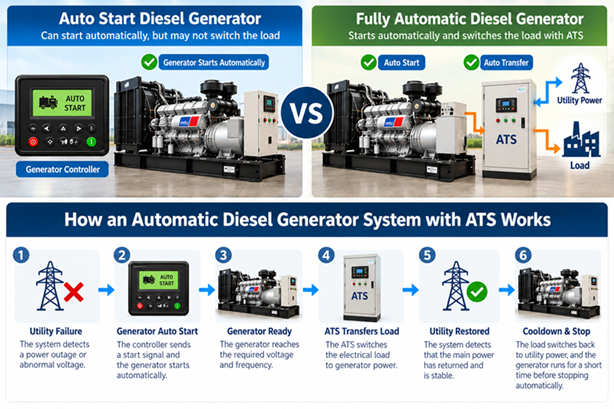
A typical automatic standby system works as follows:
- The main power supply fails.
- The generator starts automatically.
- The electrical load switches to generator power.
- When the main power returns, the load switches back.
- The generator cools down and stops automatically.
This process usually requires a generator controller and an Automatic Transfer Switch (ATS) or equivalent transfer equipment.
The generator controller manages starting and stopping, while the transfer equipment switches the electrical load between power sources.
In simple terms, auto start is one function, while fully automatic operation involves the complete power supply process.
Auto Start vs Fully Automatic: Key Differences
| Function | Auto Start | Fully Automatic System |
| Starts automatically | Yes | Yes |
| Detects power failure | Depends on configuration | Normally yes |
| Transfers power automatically | Not necessarily | Normally yes |
| Switches back when power returns | Not necessarily | Normally yes |
| Stops automatically | Depends on controller | Normally yes |
| Needs manual operation | May be required | Normally not required |
The key point is simple: a generator that starts automatically is not necessarily a complete automatic backup power system.
What Is an ATS in a Diesel Generator System?
ATS stands for Automatic Transfer Switch. Its main job is to switch the electrical load between the normal power supply and the diesel generator.
For example, imagine a factory using electricity from the local power grid. When the grid fails:
- The control system detects the power failure.
- The generator starts automatically.
- The ATS transfers the factory’s electrical load to generator power.
When the grid returns:
- The ATS transfers the load back to the grid.
- The generator runs briefly for cooling and then stops.
Without suitable automatic transfer equipment, the generator may start but cannot automatically take over the factory’s power supply.
Important: An ATS is not always included with the generator. It may be supplied separately.
Some diesel generators also use an AMF (Automatic Mains Failure) controller. It monitors the main power supply and can automatically start the generator when a power failure occurs. However, an AMF controller alone does not replace the ATS equipment needed for automatic load transfer.
Does Every Automatic Generator Need an ATS?
No. It depends on how the generator will be used.
For a factory, office building, or hospital that normally uses grid electricity, an ATS is commonly used for automatic backup power.
However, generators used in off-grid locations or systems with multiple generators may use different control equipment.
Therefore, an ATS is not required for every automatic generator application. The correct configuration depends on the electrical system and the project requirements.
Common Mistakes When Buying an Automatic Diesel Generator
Mistake 1: Thinking Auto Start Means Fully Automatic
Some buyers order an auto-start generator and expect it to automatically supply electricity during a power outage. However, the generator may only support automatic starting.
Tip: Confirm whether the system includes automatic power transfer.
Mistake 2: Assuming the ATS Is Included
Some generator quotations include only the generator and its controller. The ATS may be an optional item with an additional cost.
Tip: Always check whether the ATS is included in the quotation.
Mistake 3: Expecting Power Without Any Interruption
Even a fully automatic diesel generator normally needs time to start and take over the electrical load. It cannot usually provide completely uninterrupted power by itself. For equipment that cannot tolerate a short power interruption, a UPS (Uninterruptible Power Supply) may also be needed.
Tip: Confirm how long the equipment can operate without electricity.
Mistake 4: Ignoring Automatic Shutdown
Some buyers focus only on whether the generator can start automatically. However, the system should also be able to switch back to the normal power supply and stop the generator when appropriate.
Tip: Confirm the automatic return and shutdown functions.
What Should You Check Before Buying?
Before ordering a diesel generator, ask the supplier these questions:
- Can the generator start automatically when the main power fails?
- Can it detect a power failure automatically?
- Is an ATS included in the quotation?
- Can the system transfer the electrical load automatically?
- Can it switch back when the main power returns?
- Can the generator cool down and stop automatically?
These simple questions can help you understand exactly what you are purchasing.
For industrial projects, it is also important to confirm who will install, connect, and test the automatic transfer system.
FAQ: Automatic Diesel Generators
Is an auto-start diesel generator fully automatic?
Not necessarily. Auto start means the generator can start automatically. A fully automatic standby system normally also includes power failure detection, automatic load transfer, and automatic shutdown.
Can a diesel generator start automatically without an ATS?
Yes. A generator can start automatically after receiving a signal from another control device, even without an ATS.
What does ATS mean in a diesel generator?
ATS means Automatic Transfer Switch. It transfers the electrical load between the normal power supply and the generator.
Is ATS included with every diesel generator?
No. Some generator sets include ATS equipment, while others require it to be purchased separately.
Can a fully automatic generator provide uninterrupted power?
Not by itself in a typical standby installation. The generator needs time to start and take over the load. A UPS may be required for equipment that needs continuous power.
Conclusion
Auto start and fully automatic operation are not the same thing.
An auto-start diesel generator can start automatically, but it may not be able to switch the electrical load.
A fully automatic standby system normally includes automatic starting, power transfer, return to normal power, and automatic shutdown.
Before purchasing a diesel generator, always confirm which automatic functions are included and whether an ATS is required.
This simple check can help prevent configuration mistakes, additional costs, and problems during installation.
Want to learn more about diesel generators or need help choosing the right configuration?
Contact Us:
Whatsapp: +86 18100501828
Email: sales@calsionpower.com